There's a particular kind of 2 a.m. scrolling that leads people here. You've read the books on abundance mindset, maybe journaled a gratitude list or two, and somewhere in that search you land on a claim that sounds different from the rest: that the block isn't just in your habits or your beliefs, but in a literal, physical part of your brain — dormant, waiting to be switched back on. That's the premise behind The Last Wish, a short audio recording built around the idea that activating the pineal gland can open the door to wealth, abundance, and prosperity. It's a compelling story. We wanted to know how much of it holds up, so we read the sales page closely, checked its claims against what's publicly documented, and traced the idea back to where it actually comes from. Here's what we found.
5 Reasons Third Eye Practice Usually Stalls
Most people who feel drawn to this topic aren't naive. They've already tried something, and it didn't stick. These are five common frustrations, and they're worth naming before looking at any product.
1. You can't tell whether anything is happening
Sitting quietly with your eyes closed gives very little feedback. After a week you're left asking whether you're doing it wrong, whether you're "blocked," or whether there's simply nothing to notice. Without a clear sense of progress, most people drift away from the practice.
2. The information is a tangle of history, symbolism, and pseudo-science
Egyptian imagery, chakras, Descartes, and half-understood neuroscience all get blended into one confident-sounding story. It's hard to know which parts are cultural symbolism, which are real biology, and which are marketing. That confusion makes it difficult to trust anyone.
3. Most programs ask for too much time
A 30- to 45-minute daily routine sounds fine on a quiet Sunday. By the second week, work, family, and tiredness win. A practice only helps if you actually do it, and long ones rarely survive a busy schedule.
4. You've been burned by programs that overpromised
If you've paid for a course that promised a transformation and delivered a PDF, you're right to be wary. That caution is healthy, and it's why we put so much weight on refund terms and unverified claims in this review.
5. You're curious, but you don't want to be fooled
You can be open to mindset work and still insist on straight answers. Wanting to know what's proven, what's symbolic, and what's just a good story is a sensible instinct, not cynicism.
No single audio track solves all five. A short daily routine speaks directly to problem 3, honest labeling of what is and isn't verified addresses problems 2 and 5, and a long refund window softens problem 4. The rest of this review shows how The Last Wish measures up on each.
Why Manifestation Pulls So Many People In
Before judging any single product in this space, it's worth sitting with why the broader idea of manifestation is so magnetic in the first place. At its core, manifestation asks a fair question: how much does mindset shape outcome? Athletes visualize the shot before they take it. Entrepreneurs describe "seeing" the business before it existed. There's a real, well-studied psychological phenomenon behind some of this — focused intention changes what you notice, what risks you take, and what opportunities you act on. That's not mysticism; that's attention and behavior.
Where manifestation content gets more speculative is the leap from mindset shapes behavior to mindset directly rearranges external reality — that thinking about wealth pulls money toward you through some unmeasured energetic mechanism. The pineal gland framing sits right at that fault line: a real, biological structure wrapped in a claim about energy and prosperity that goes well past what neuroscience has confirmed. Understanding that fault line is exactly what makes a curious reader a better-equipped one, whether or not you end up trying the product.

Why Mindset Work Actually Matters
It's easy to wave off "abundance mindset" language as fluff, especially once you've seen it stretched into pseudo-scientific claims. But underneath the marketing, there's a genuinely important idea that's worth taking seriously on its own terms. The people who move toward the life they want — more financial security, more creative freedom, more sense of possibility — tend to share a specific habit: they rehearse it mentally before it happens. They picture themselves handling the negotiation, running the business, living differently, long before the external evidence arrives. Psychologists call pieces of this self-efficacy and cognitive priming; the manifestation world calls it visualization and abundance mindset. Different vocabulary, overlapping territory.
This is why curiosity about manifestation deserves more respect than it usually gets in skeptical circles. Being curious about how belief shapes behavior, how a daily ritual can rewire what you notice and act on, how scarcity thinking quietly forecloses opportunities before you even see them — that's not naive. It's one of the more practical questions a person can ask about their own life. The mistake isn't in taking mindset work seriously. It's in skipping the mechanism and jumping straight to magic, the way a lot of marketing in this space does.
That's the lens we brought to The Last Wish: not "is this real magic," but "is this a genuinely useful entry point into mindset and prosperity work, dressed in a story that makes people actually stick with it?"

What Exactly Is The Last Wish?
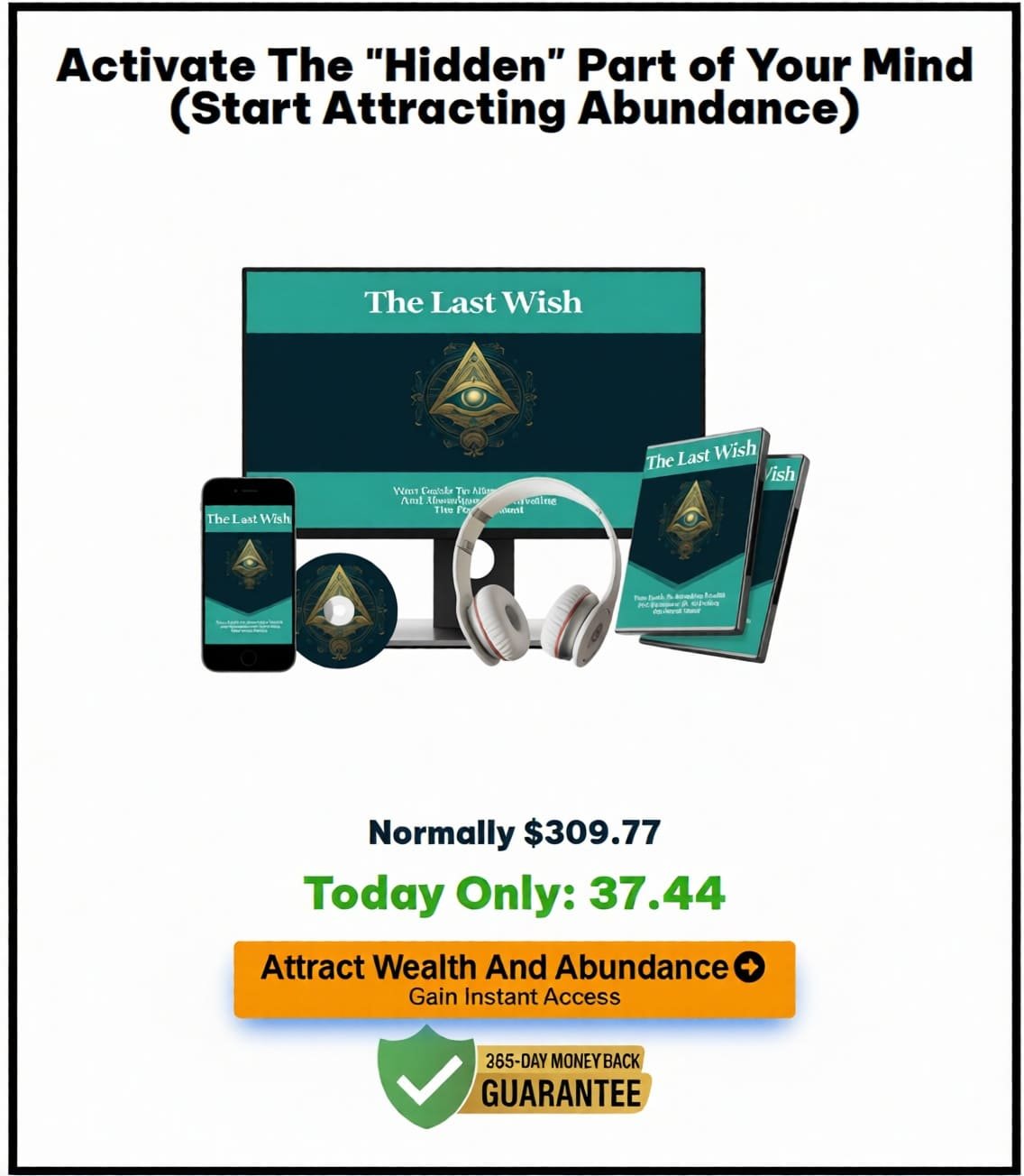
Strip away the mythology and the mechanics are almost anticlimactic: The Last Wish is a digital audio track — not a supplement, not a device, just sound. You listen with headphones for roughly seven minutes at a time. The track layers specific tones underneath ambient music, a technique broadly known as audio or brainwave entrainment, which has quietly powered meditation apps and sleep tools for years, long before anyone attached a wealth narrative to it.

The story wrapped around that sound is where things get interesting. The pitch centers on the pineal gland — a small, pea-sized gland in the brain that does have a real, well-documented biological function: it produces melatonin and helps regulate your sleep-wake cycle. The product's narrative goes further than mainstream physiology, framing this gland as a dormant "spiritual organ" that can be reawakened through sound to unlock abundance and prosperity. It's a good story — the kind that makes a seven-minute ritual feel like it's doing something bigger than relaxation. Whether it's a true mechanism or a powerful metaphor is worth understanding before you decide what to make of it, so we went looking for where the idea actually began.
The Third Eye Idea — Where It Actually Comes From
The "third eye" concept didn't start with a ClickBank sales page. It shows up in Hindu and Buddhist iconography as the ajna chakra, in Egyptian imagery as the Eye of Horus, and in esoteric Christian mysticism as a symbol of inner spiritual sight. French philosopher René Descartes even called the pineal gland the "seat of the soul" back in the 17th century, long before anyone had scanned a brain. We wrote a full breakdown of that history — worth a read if you want the context before the pitch:
"Descartes called it the seat of the soul three centuries before neuroscience had a word for melatonin."
→ Read: The Third Eye in History — From Egypt to Modern Neuroscience
What About the Research Claims?
The sales page states the audio is "backed by research from Harvard and University of Michigan." That's a specific, checkable claim, and in the interest of an honest review, we'll be straightforward: we could not locate a published study from either institution that validates this exact product or its wealth-manifestation claims. That doesn't necessarily mean the underlying mechanism is fabricated — it means the specific citation is unverified, and you should treat it as a marketing claim rather than a confirmed fact.
What is genuinely backed by research is the broader category the product borrows from: audio entrainment and guided meditation have real, peer-reviewed research behind their ability to shift brainwave activity toward relaxed alpha and theta states, which are associated with lower stress and improved focus. We go deeper into that research — and where it stops short of "third eye activation" — in a separate piece:
→ Read: Binaural Beats and the Brain — What the Science Currently Supports
The 7-Minute Method
Picture the version of this that actually happens in most people's lives: not a candlelit ritual, but a Tuesday morning, coffee still brewing, five minutes carved out before the day pulls you under. You put the headphones on, close your eyes, and for seven minutes the only job is to not check your phone. That's genuinely most of the practice — the tones and the mythology are doing their work in the background, but the real mechanism on the surface is just: a small, protected pocket of stillness, repeated daily, that most people don't otherwise give themselves.

Part of what makes this kind of ritual stick isn't the mysticism — it's the simplicity. A seven-minute ask is small enough that "I don't have time" stops being a believable excuse, which is exactly the kind of low-friction habit that makes consistency possible in the first place:
- Put on a pair of headphones — stereo separation matters for entrainment audio to work as intended.
- Find a quiet spot where you won't be interrupted for about seven minutes.
- Press play, close your eyes, and let the track run without multitasking.
- Repeat daily; the guide recommends consistency over a single long session.
4 Things You Get for $37.44
This isn't just a single audio file — it's a small starter kit for the whole practice. Beyond the core recording, the package currently bundles three companion guides designed to be used alongside it, not as filler:

The Official Guide
A short walkthrough on getting the most from each listening session and building a consistent routine.

Pineal Gland Decalcification Plan
Lifestyle and dietary suggestions the creators frame as supportive of the process. Not medical advice — see our note below.

The Wealth Scripts
Written affirmation scripts meant to be read alongside the audio — a common pairing in manifestation-style programs.
Four pieces total, delivered instantly to your device, for less than the cost of a single therapy session or coaching call. Whatever you make of the wealth-attraction framing, the practical value of the bundle stacks up.
Pros and Cons — Our Honest Take
What we liked
- Low time commitment — about 7 minutes a day, no equipment beyond headphones.
- Inexpensive relative to most meditation or coaching programs.
- 365-day money-back guarantee through ClickBank removes most financial risk.
- Rooted in a real relaxation technique (audio entrainment), even if the marketing overstates it.
Where we'd push back
- The specific "Harvard / University of Michigan" claim isn't independently verifiable.
- "Attracting wealth" is a subjective outcome — there's no mechanism by which audio alone changes your bank balance.
- Results (relaxation, focus, mindset shifts) will vary a lot person to person.
- Not a substitute for financial planning, medical care, or mental health support.
$37.44 and a 365-Day Guarantee: The Pricing, Explained
At the time of writing, The Last Wish is priced at $37.44, discounted from a listed $309.77. Treat the "today only" framing as standard direct-response marketing rather than a literal deadline, and confirm the current price on the checkout page before you buy. Every order is backed by a 365-day ClickBank refund window, which is unusually long and worth factoring into your decision.

365-Day Refund Window
Because it's sold through ClickBank, refunds are processed by the retailer, not the product creator directly — which tends to make the process more consistent.
3 Steps to Order (What Actually Happens)
If you've never bought through ClickBank before, the process is faster than it looks — here's exactly what happens after you click:
Click "Get Instant Access"
You'll leave this page and land on ClickBank's secure order form — the same encrypted checkout used across their platform, not a third-party redirect.
Enter your details
Basic billing info and payment method. The order confirms in under a minute — no account creation required.
Get instant access
Your download link and all three bonus guides arrive by email immediately, so you can start your first session tonight.
Worth trying if you go in with the right expectations
We wouldn't recommend The Last Wish as a literal wealth-attraction mechanism — no audio track can do that, and we think the marketing overreaches. But as a low-cost, low-effort entry point into daily meditation and relaxation practice, wrapped in a compelling mythology that some people find genuinely motivating, it holds up reasonably well — especially with a full-year refund window backing it.
Who This Is — and Isn't — For
This will probably resonate if you're genuinely curious about manifestation and mindset work — if you've already sensed that how you think about money and possibility shapes what you notice and act on, and you want a structured, low-effort daily ritual that keeps you actually practicing that instead of just reading about it. It's less likely to land if you need peer-reviewed clinical evidence before trying something, or if "attracting wealth" framing feels off-putting rather than motivating. Either reaction is reasonable — this is a mindset and relaxation tool dressed in spiritual language, not a financial product, and the value it offers lives in the daily habit, not in the myth around the gland.
Frequently Asked Questions
Is The Last Wish backed by real science?
The general category — audio entrainment and meditation — has real research behind its effects on relaxation and focus. The specific institutional citations on the sales page ("Harvard and University of Michigan") could not be independently verified by us and should be treated as an unconfirmed marketing claim.
How long until I notice anything?
The creators suggest consistent daily use over several weeks. Any effects reported by users are most plausibly tied to the relaxation and focus benefits of regular meditation-style practice, not a physical change detectable without medical imaging.
Is it safe to use?
Audio entrainment tracks are generally considered low-risk for most listeners. As with any flashing-light or rhythmic-audio product, people with a history of seizures should consult a doctor first. This is general information, not medical advice.
Where is it sold, and is my payment secure?
The Last Wish is sold exclusively through ClickBank, an established digital retailer that handles payment processing and refunds independently of the product creator.
Can I get a refund if it's not for me?
Yes — ClickBank offers a 365-day money-back guarantee on this product, which is longer than most digital programs in this space.